
American Accent/Pronunciation

It is often very difficult for adult learners of English to change their pronunciation. Together we can explore where improvements are possible. Combining your aptitude with great effort over time, you may modify your pronunciation to achieve speech that is closer to an American-English accent.
The Process:
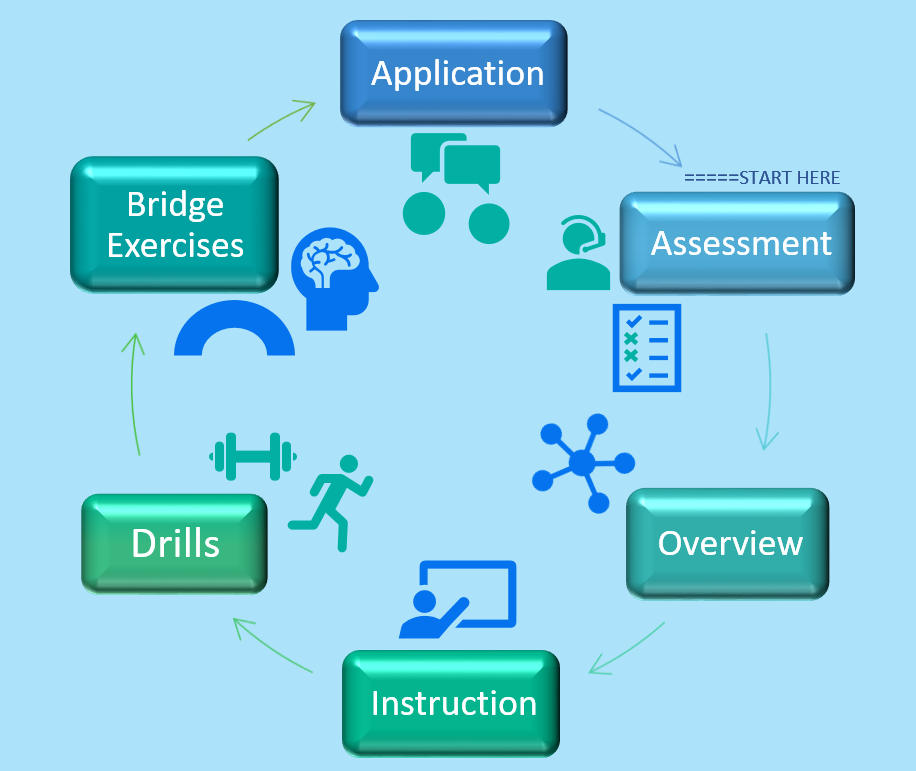
Assessment
First we will assess your specific areas for improvement. There are many assessment tools that we can use. These include sentence sets to be read aloud to check for specific vowel and consonant sound pronunciation, to open-ended questions for more natural conversation evaluation. We can also use your speech remarks for an upcoming presentation or reports you've written for work to read aloud for assessment so that we can quickly target improving pronunciation of vocabulary and phrases that you need to use most in your career.
At your request, we can record your voice as you perform the assessments to serve as a baseline for better empirically measuring your progress.
Overview
Some of my clients ask for an overview of all the American-English vowel sounds and consonant sounds (including consonant clusters) so that they can feel oriented. So that you do not have to memorize more complicated symbols from the International Phonetic Alphabet (IPA), I use a simplified, intuitive, phonetic transcription system, which can be further personalized for your practice.
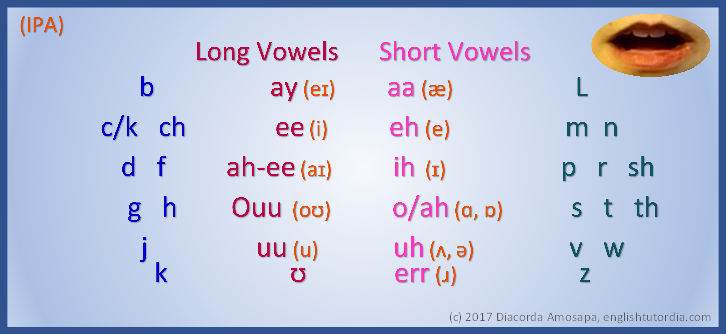
I can also provide overviews of the elements of stress and the principles of word linking, which are more advanced topics that are essential for achieving improved American-English pronunciation.
Instructions
After identifying your areas for improvement, I will explain to you in necessary detail how to fix your mouth positions. For particular sounds you may need to open or close your jaw more, widen or purse your lips, or change the position of your tongue. I will demonstrate with my own mouth, show you easy-to-understand diagrams, and even use cool MRI scans to show you tongue positions, such as seen here!
Drills
As we correct your pronunciation, you will repeat, repeat, repeat the correct sound forms. This repetition is very important for building your brain and mouth memory for the new mouth positions. I can also create customized audio recordings for you so that you can practice on your own between our sessions for faster progress. These clips are normally made during the last segment of the session in collaboration with the client, providing a useful summary review.
Here are some real audio recordings I have made with clients:
This clip was for a client who is involved in IT project management. Notice what I call the hidden pivot Y sounds in Agile and scaled, that are clearly included in my phonetic transcripts and pronounced in the American accent, but are always hidden in English spelling.
Also notice how the final syllables cally in basically and practically experience a complete vowel sound removal of the spelled a. This is also very characteristic of American-English pronunciation.
~ Audio Transcript:
Agile - AA jah-ee YuL
scrum - skerr RUhM
basically - BAYee sih klee
practically - PRAAK dih klee
scaled – SKAY YuLd
This clip was for a public health specialist. The two words here have many complex pronunciation properties that can be difficult to execute, such as the "err" sound, the Long u off-glide on the Long O sound, and the essential "y" sound between the cu spelling in both words.. To help the client achieve sound correction for tuberculosis, I designed the clip to build from the center of the word outward syllable by syllable.
~ Audio Transcript:
molecular - muh LEhK kyuu lerr
LOuu
kyuu LOuu
berr kyuu LOuu
tuberculosis - tuu BERR kyuu LOuu* sihs
After my client, an economics scholar from Japan, read aloud an article of interest, these challenging words were collected for additional practice. Notice the use of katakana script to help map a sound in the word myopically to the client's native language for accelerated learning.
~ Audio Transcript:
exogenous - ehg ZAh jin nihs
alleviation - uh LEE vee YAY shihn NOT vee 'AY shihn
itinerary - ah-ee TIN nerr ray yer ree
whistleblower - WIhSS Sul BuhLOuu werr
dossier - DAh see yay
referendum - Reh ferr REN duhm
tumultuous - tuh MUL chuu wihs
rehypothecation - ree hah-ee pah thuh KAY shihn
myopically - mah-ee Yアア piiiiih klee
Bridge Exercises

So now you can pronounce the corrected form of the target single sound or word. But how can you take this new knowledge and put it back into your normal conversation? This is achieved through bridge exercises. These exercises bridge the gap between single word practice and more complex conversation.
These exercises include:
~ pairing the target sound(s) word with a word commonly used before it and after it.
Example: "applying Agile", "Agile framework"
~ practice saying challenging yet creative and fun sentences with multiple target words.
Example: "Exogenous assistance is needed to achieve alleviation of the tumultuous effects of the referendum.")
~ rehearsing useful sentences that you would apply in your daily conversation, presentations, and other real-world settings
Example: "It's practically done already." "Here is a diagram of the sample's molecular composition.")
~ hearing me ask a question or make a statement and you choosing between 3 realistic sentences with the target sound/word to say that would be the most logically appropriate response.
Example: Q: How are your travel plans coming along?
+ The referendum itself went smoothly.
+ I finalized my itinerary yesterday. *
+ Three main exogenous factors are involved.
This last exercise especially helps with combining your new pronunciation knowledge with the other cognitive processes that occur during real conversation.
Application
We will have our natural conversation practice during sessions, during which if you slip back to the earlier pronunciation form instead of your new form, I will first give you a silent visual signal or say the phrase leading to the target word, so that you have an opportunity for self-correction. If you are still not quite sure what what the slip was, I will share with you the corrected form and we can do on-the-spot drilling to reinforce your learning. Then we will continue with the conversation for opportunities for you to practice your improved pronunciation.

Outside of our sessions, whether during daily conversation or your presentation, it will be crucial for you to add an extra layer of awareness when you are speaking, to slow down (something many of clients need to do anyway to improve their American accent) and anticipate when you are about to say a target word so that you can say the new corrected form. It is natural that during the learning process you may slip and not be able to say the corrected word form the first time. I encourage you to immediately correct yourself when you feel comfortable doing so in that conversation or presentation setting, and with continued diligence you will develop your ability to pronounce the correct form the first time!
The chart below lists several topics on pronunciation that you can explore with me.
Voiced TH this, that, weather
Unvoiced TH think, thought
Letter T as glottal stop
Letter T as "d" water, city
S as "s"
S as "z" is, was, busy
Letter C as "k"
Letter C as "s" ceiling, space
Letter G as "g"
Letter G as "j" change, gem
Letter Y as "y"
Letter Y as "ee" city, copy
NG evening, hungry, talking
B vs. P
W vs. V vs. F
R vs. L
M vs. N
N vs. NG
QU quick, quiet, liquid
CH chair, choose, much
SH share, dishwasher, cash
"ZH" usual, vision, pleasure
DU and D + Y as "j"
Word Ending ED as "ed" & "t"
Vowel sounds
Short I it, is, in
Short E end, get, said
Long E "ee" eat, ski, he
Short A at, as, has
Long A came, paper, day
"Ah" saw, father, lot
"oo/u" book, took, put
Long O no, so, road
Long U/"oo" to, do, food
Short U until, of, was
Diphthongs sky, out, choice
Consonants
Voiced -
m, n, l, r, w, y
b, d, g, v, th, z, j,
Unvoiced/Voiceless –
p, t, c, k, f, th, s, h, sh, ch
Continuants –
m, ng, n, r, l, f, v, h, w,
wh, th, s, sh, z, zh
Stops –
p, b, k, g, t, d
Word Linking
Consonant to Consonant
Consonant to Vowel
T to Vowel
Vowel to Vowel – hidden "y"
Vowel to Vowel – hidden "w"
Stress
Pitch/Intonation
Contractions
Consonant Clusters
BL blank, blend, publish
BR break, brief, library
CL clear, clothes, include
CR create, increase, sacred
FL floor, flow, reflect
FR from, fresh, proofread
GL glad, globe, English
GR grow, great, program
PL play, place, apply
PR product, provide, print
SC scope, rescue, disc
SCR screen, ascribe, scrap
SK sky, skill, ask
SL sleeve, legislate, piously
SM smile, smart, transmit
SN snow, sneaker, unsnap
SP speak, inspire, grasp
SPR spring, spray, spread
ST stay, lasting, cost
STR street, instruct, pastry
SW switch, swivel, sweet
XT text, extend, external
CT fact, practice, select
TS its, sets, benefits
TR as "chr" trip, train, country
DR as "jr" drink, draft, laundry
You can email me at contact@englishtutordia.com to schedule your first (free!) video chat consultation.